
Winter in Kharkiv

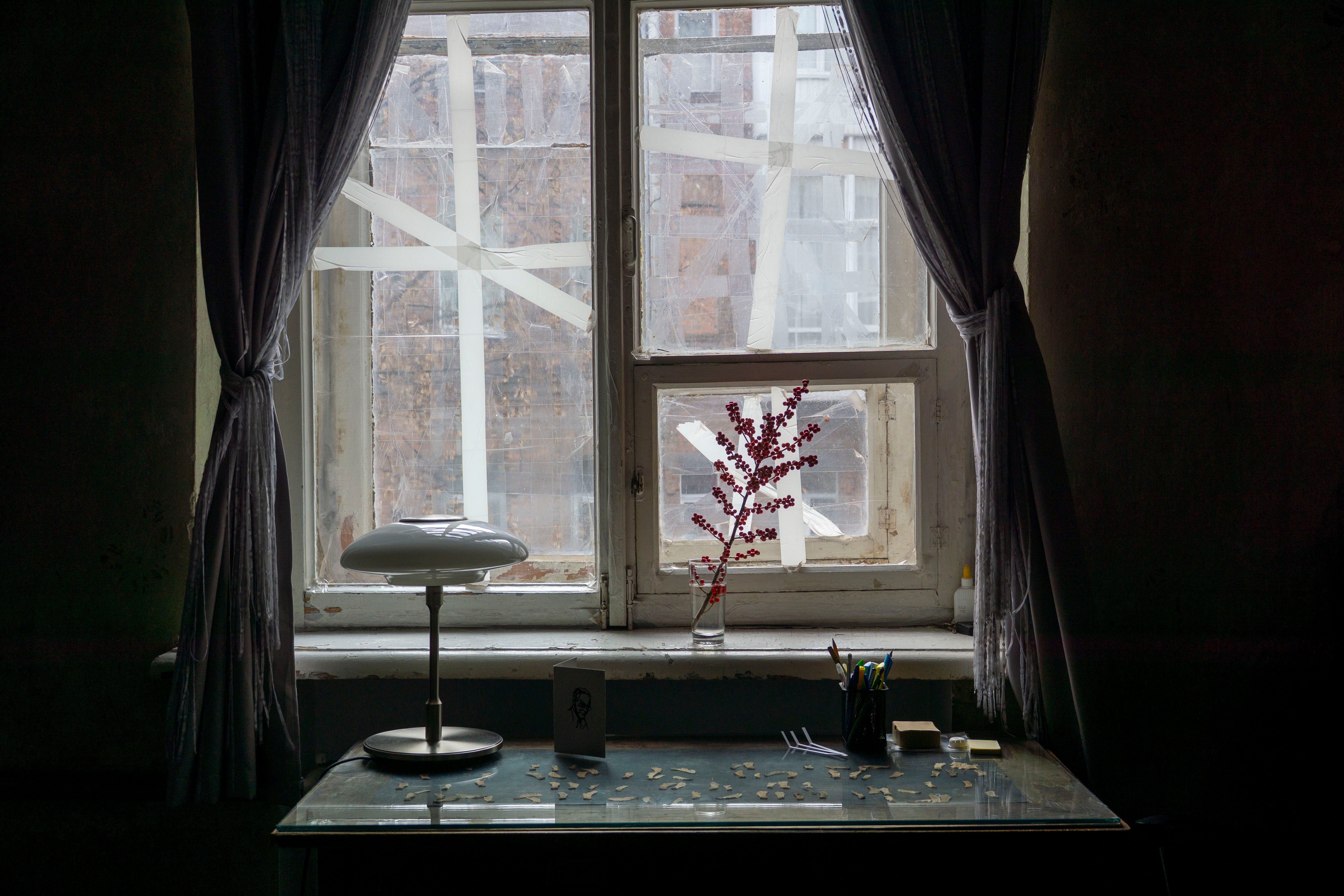
The room where I work this winter is spare: a writing desk, a lamp, a shelf filled with books. The window is taped against blasts, and when I look up from the page I see the world through these Mondrian squares: glimpses of brick, cement and wooden panels.
It is December in Kharkiv. I am in the historical House of Slovo Residency run by The Literature Museum. In the 1920s it was built as a home for Ukrainian writers, a place of language and creation. A decade later many of its residents were arrested or killed in Stalin’s purges. The building still holds those silences. Working here means writing in the presence of those who never had the chance to finish their own sentences.
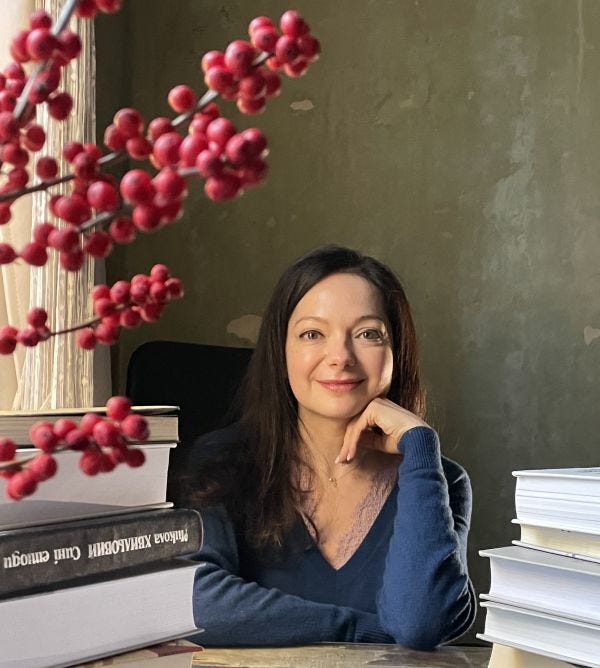
I live in the apartment that once belonged to Yuriy Shevelyov. The space has its own gravity. It holds the traces of the writer and linguist who once lived here, a man who spent his life defending the Ukrainian language with precision and courage.
As I write, I glance at my phone to track the movement of missiles from the east. Kharkiv is twenty kilometers from the Russian border, its defenses are thin, and being here requires accepting a certain degree of risk. In truth, that risk belongs to every corner of Ukraine.
I am learning which alerts matter, which abbreviations signal danger, which nicknames refer to the weapons that cross the sky toward the city.
It sounds like madness to come here in the middle of a war, madness to take up a writer’s residence in a place so exposed and vulnerable.
But it also feels necessary. My work is to record how art and cultural heritage are protected during war, and how creative work becomes the thread that holds a community together. I trace things that are fragile. I record stories. I meet museum workers, writers, artists, volunteers. I travel to villages and discover curators who preserve extraordinary collections: embroideries, paintings, icons, ceramics. Often they work in conditions that should make preservation impossible.
Kharkiv feels so familiar that it is hard to believe I truly discovered it only after 2022, except for one memorable visit a decade ago with my grandmother. She came here as a young geology student, fell in love, and married my grandfather. My mother was born in Kharkiv.
Perhaps that is why the city feels woven into my inner map, part of my personal geography in a way that feels almost fated.
My first week has already taken on a rhythm of its own: part study, part movement, part adaptation. I taught two ISIPCA classes from the desk in Shevelyov’s apartment, the air raid sirens wailing as I spoke to my students in Versailles about fragrance history and raw materials. In the quiet hours, I read a book of poetry I found on the shelf, its old margin notes underlining lines about vigilance and desire.
I visited three museum exhibits, reminders of how fiercely cultural life endures here. I attended three lectures. I learned about Kharkiv’s metro enamels, an entire subterranean gallery and the largest collection of enamel art in the world. I celebrated a friend’s birthday in Trypichcha, the restaurant that opened after the start of the full-scale invasion.
Then I earned my Tactical Combat Casualty Care certificate, a small but meaningful step toward knowing how to save a life when seconds matter. And somewhere along the way, I learned to open a bottle of wine with a knife, a skill I did not know I needed until a curfew made a corkscrew impossible to find.
And because scent is always my compass, I began tracking the aromas of the city: diesel and frost in the mornings, the warm poppyseed rolls of street bakeries, the metallic chill of the metro, the unexpected sweetness of someone’s perfume in the street. Even here, fragrance becomes a way of mapping space, proof that beauty persists in the smallest molecules.
When I reflect on this week, what strikes me most is not the contrast between danger and normality, but the way people move through it with purpose. Art is made, poems are read, lectures continue, wine is opened, friendships expand. The life isn’t normal in any sense of this word and I hear so many tragic stories that I often feel overwhelmed with grief. And still the city lives and breathes.
Perhaps this is what Kharkiv teaches you the most. You do not wait for perfect conditions to do meaningful work. You create inside imperfection, inside uncertainty, and trust that this, too, is a form of living your life to the fullest.
Images: 1) by Petro Chekal. 2) and 3) my own like all other photos in my newsletters and notes.
Coming up for paid subscribers: I’ll share my writing process and field notebook from my first week in Kharkiv — raw fragments, early scenes, and sensory vignettes.
The residence where you live sounds like a very special place, Victoria, I hope you can have many contacts with other residents or is it almost empty? One of my cousins filmed my grandmother forty years ago and questioned her about the war and occupation. I was struck watching it for the first time recently when she said what she felt most was rage. Her husband, my grandfather, a member of the OCM was deported and killed in a concentration camp in Silesia. At times, do you experience such a feeling too?
Un normal is the new normal unfortunately